You have no items in your shopping cart.


Sabelt's Silver Series Enduro is an FIA-homologated 6-point racing harness designed around the realities of actually getting into, adjusting, and driving a race car.
Two-inch webbing throughout, lightweight aluminum hardware, a compact cam-lock buckle, fast cockpit adjustment, HANS-friendly shoulder belts, and both pull-up and pull-down lap-belt configurations make this one of our favorite harnesses for track and race cars.
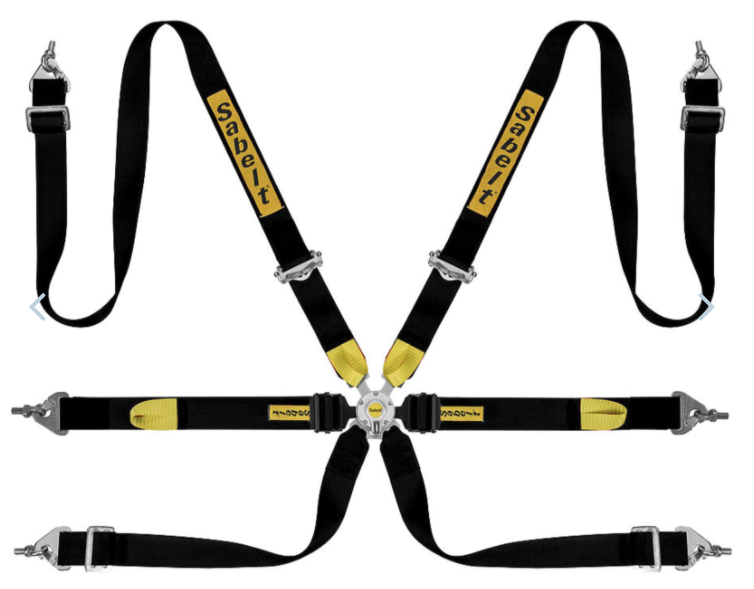
The current Silver Series Enduro replaces the older combination-width design with 2-inch webbing throughout the shoulder, lap, and sub-belt system.
The belts are paired with lightweight aluminum hardware and Sabelt's compact cam-lock buckle, which integrates the sub-belts directly into the buckle assembly.
Bright yellow adjustment tabs make the harness easy to tighten from the driver's seat, whether you're strapping yourself in or trying to make a quick driver change.
A racing harness needs to restrain the driver properly, but a good one should also be easy to adjust, easy to manage, and compatible with the rest of your safety equipment.
Two-inch shoulder, lap, and sub belts provide a compact and comfortable harness package.
Lightweight aluminum adjusters and hardware keep unnecessary mass out of the harness assembly.
The redesigned buckle integrates the sub-belt connections into the main fixture for a cleaner central assembly.
Large, bright adjustment loops make tightening the harness easier when space and visibility are limited.
Three-inch belts were the standard for years, and plenty of us ran them because that's simply what racing harnesses looked like.
But more belt width does not necessarily mean more comfort or a better fit—particularly across the pelvis.
After years of using 3-inch Sparco harnesses, we switched to modern 2-inch belts like these in our own race car.
The 2-inch lap belts fit the pelvis noticeably more comfortably, and we haven't found any meaningful comfort disadvantage to the 2-inch shoulders compared with the 3/2-inch HANS-style shoulder belts we ran previously.
There are a lot of excellent harnesses on the market. We like the Silver Enduro because the basics are right, the hardware is excellent, the adjustment is easy, and Sabelt added a bunch of little details that become extremely useful once you're actually sitting in a race car.
The ability to configure the lap belts as either pull-up or pull-down is particularly useful because cockpit geometry varies dramatically from one car and seat installation to another.
In actual use, we'd put these right alongside the other premium endurance-style harnesses we've used—except Sabelts also have the useful habit of generally being available when we need them.
Product photos are useful. Seeing the harness installed in a real cockpit is better. These are Sabelt Silver Enduro harnesses installed in one of our own track cars.

The bright yellow pull tabs are easy to locate from the seat, and the 2-inch webbing sits cleanly through the harness openings without a pile of excess material.

Compact hardware and 2-inch belts make for a clean installation around a proper race seat without unnecessarily bulky adjusters fighting for space beside the driver.
The Silver Enduro package includes both configurations, so you aren't forced to choose the adjustment direction before knowing which one actually works best once you're sitting in the car.
Useful where the cockpit and seat geometry make it easier to grab the belt and pull inward/upward toward the buckle to tighten it.
Often easier in installations where the adjuster is accessible beside the seat and the belt can be pulled outward/downward to tighten (most common for Corvettes).
Silicone grip material on the underside of the shoulder belts helps keep them positioned on your head-and-neck restraint.
Routing provisions on the shoulder straps help keep communication and hydration lines secured instead of floating around the cockpit.
Velcro sections on the shoulders keep the harnesses out of the way either for driver changes, or simply sticking to your seat between sessions so they're not falling behind your back all the time.
This isn't about matching your roll cage, your seat, or your Instagram aesthetic.
In an emergency, safety crews may need to identify and release your harness very quickly. Making the belt visually distinct from the driver's suit can make that job easier.
Black suit? Consider red or blue belts. Red suit? Black or blue. It's a small decision made while ordering the harness that may matter a lot more than how coordinated the interior looks.
A multi-point harness is part of a complete driver-restraint system—not an isolated safety upgrade.
Make sure your seat, harness mounting, belt geometry, helmet, and head-and-neck restraint are all appropriate for one another and for the rules governing the events you're running.
Harness performance depends on proper mounting geometry, seat compatibility, belt routing, and installation. Always follow Sabelt's installation requirements, the labels on the harness, and the rules of the sanctioning organization or event in which the car will be used.