You have no items in your shopping cart.


The rear brakes don't get to take the afternoon off just because the front axle does more of the stopping.
A serious C8 track car still asks the rear system to absorb substantial energy, maintain the correct brake balance, cooperate with ABS, and deliver the same response lap after lap.
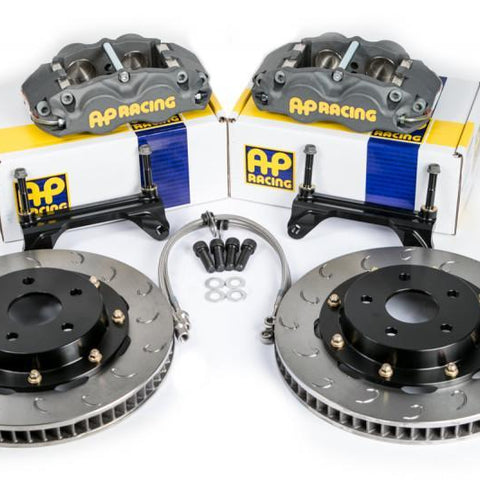
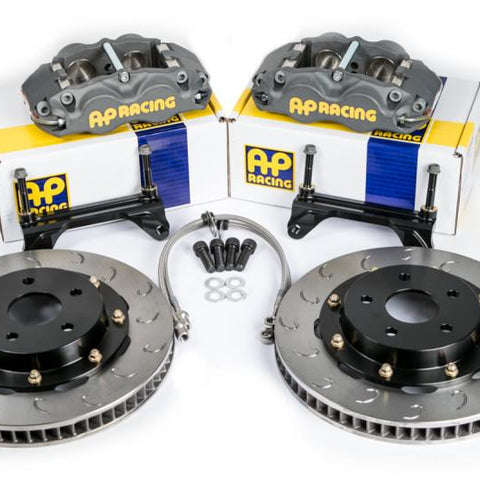
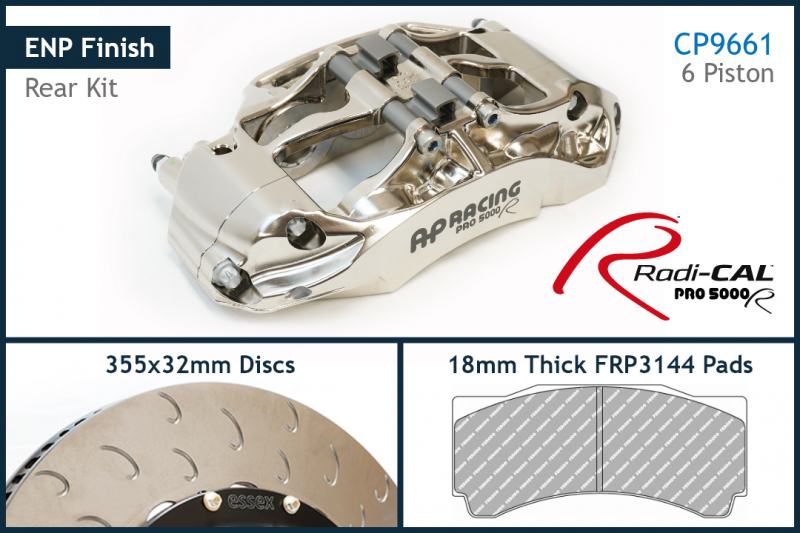
The AP Racing by Essex CP9661 / 355mm rear Competition Kit combines six-piston Radi-CAL calipers, 18mm-thick motorsport pads, ventilated stainless-steel pistons, anti-knockback springs, and fully floating 355x32mm 72-vane J-Hook discs in an extraordinarily compact and lightweight package.
Brake balance matters. Pedal consistency matters. Rear tire loading matters. And as speeds, grip, aero load, and session length increase, the rear brakes have to survive the same increasingly hostile environment as everything else on the car.
A stiff caliper and properly controlled piston movement reduce variables in pedal travel and response as the system heats up.
355x32mm racing discs with 72 curved vanes are designed to absorb and reject repeated braking energy rather than merely survive street use.
Essex chooses piston sizing around the C8's hydraulic system so the rear brake package integrates properly rather than radically shifting axle balance.
Despite adding two pistons and a larger racing disc, the complete system removes roughly 12 pounds from the rear axle versus the factory Z51 brakes.
We ran AP Racing systems exclusively on our C5 race car for seven years. During that time, we never once gave serious thought to whether the braking system was capable of doing what we were asking from it.
We're now asking the same thing from a roughly 3700-pound C8 on slick tires and substantial aero. Still no drama.
That's really the highest compliment we can give a brake system. When you're heading into a braking zone at speed, you already have enough things to think about. Whether the brake pedal will be where you left it shouldn't be one of them.
Traditional calipers tend to look like boxes because boxes are convenient to manufacture.
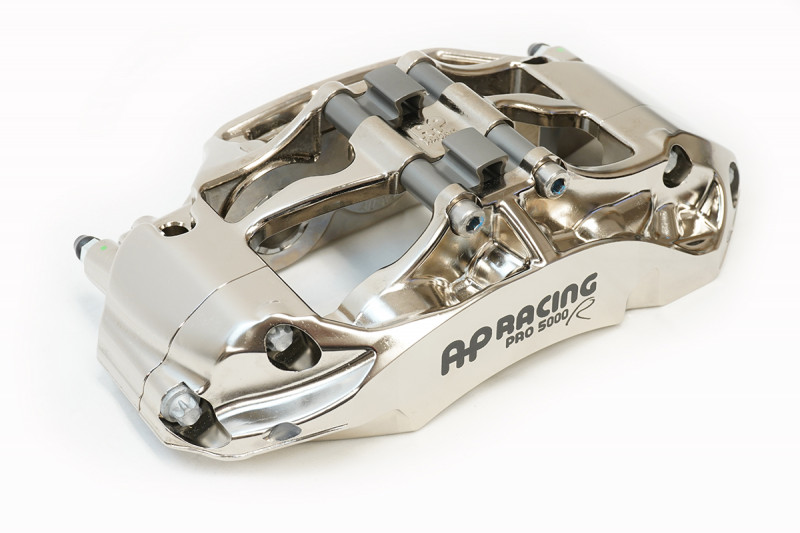
AP Racing's Radi-CAL architecture puts material where the caliper actually needs it during a braking event. The asymmetric structure is designed around the tangential forces trying to twist the caliper while the pads clamp a rotating disc.
AP's Radi-CAL architecture delivers more than a 30% increase in static and dynamic stiffness compared with conventional caliper designs while simultaneously removing material that isn't carrying useful load.
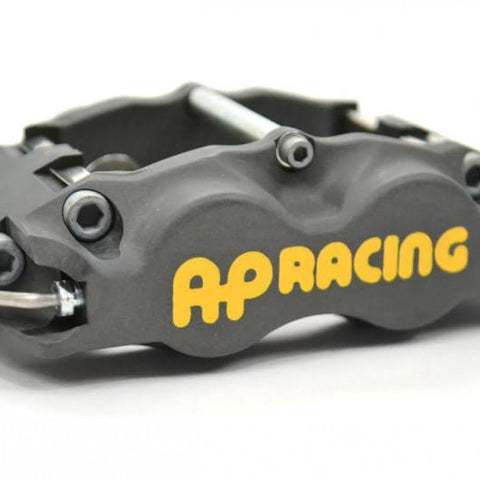
The result here is a six-piston rear caliper weighing only about 6.2 pounds without pads.
Less caliper deflection means less pedal movement wasted flexing the caliper and more consistent pressure across the pad.
The CP9661 weighs approximately 6.2 lb without pads despite using six pistons and a full-size motorsport pad.
No external crossover tubes means fewer vulnerable components hanging off the caliper and more room around the wheel.
The 18mm-pad architecture and optimized caliper body keep the package narrow enough to work with surprisingly small track wheels.
AP uses machined stainless-steel pistons rather than conventional aluminum pistons to create a thermal barrier between the screaming-hot brake pad and the hydraulic fluid behind it.
The pistons are also ventilated and use AP's domed-back architecture for additional stiffness.
Behind the pistons are anti-knockback springs. When cornering loads cause the hub and disc to deflect, the rotor can push the pads and pistons backward into the caliper.
Those springs help maintain piston position so the next brake application doesn't begin with your foot taking up a bunch of surprise clearance.
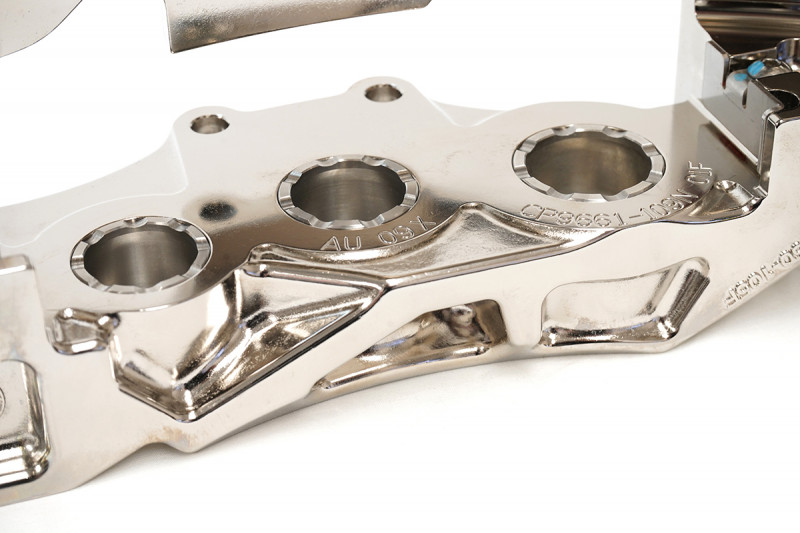
Virtually every major detail in the Pro5000R exists because brake temperature on track is dramatically different from what a production street brake normally experiences.
Motorsport piston seals are designed to tolerate repeated high-heat use without the short service life associated with ordinary street caliper components.
Bellows-style dust boots can burn and deteriorate at racing temperatures, so Pro5000R competition calipers simply eliminate them.
Electroless Nickel Plating creates a hard, thin, durable finish that tolerates track heat and frequent servicing without cooked paint flaking off the caliper.
Just like the CP9660 and CP9668 front calipers, the difference between these rear systems is not simply that one number is larger.
The CP9661 / 355 package is built around an 18mm-thick pad and compact 355x32mm disc. The CP9669 / 378 steps up to a 25mm pad and 378x34mm disc when maximum consumable and thermal reserve matter more than minimizing package size and mass.
18mm pads, 355x32mm discs, excellent wheel clearance, substantially lower unsprung mass, and plenty of brake for the vast majority of HPDE, time-trial, and sprint-race C8s.
25mm pads and 378x34mm discs provide additional pad volume and thermal reserve for endurance racing, extremely heavy consumption, or cars repeatedly generating enormous rear-brake temperatures.
The CP9661 is designed around frequent pad changes and service.
The bridge hardware can be removed without taking the caliper off the car, giving direct access to the pads from the top of the caliper.
AP also designed the caliper around an extremely common motorsport pad shape, so you're not locked into some bizarre proprietary consumable that becomes unobtainium the weekend before an event.
The caliper gets all the glory, but the disc is the component actually converting the kinetic energy of the car into heat. That's why so much of the engineering in a real competition brake system lives in the rotor.
The iron ring is free to expand radially relative to the aluminum hat as temperature increases, reducing coning, distortion, stress, and uneven pad contact.
Left- and right-specific curved internal vanes actively pump cooling air through the disc rather than relying on a simple straight-vane architecture.
AP's J-Hook slots help manage the pad face and provide consistent bite while avoiding unnecessary drilled holes through a competition-level disc.
Heat-treated aluminum hats reduce unnecessary rotating mass while also reducing heat conduction into the hubs and wheel bearings.
As a brake disc heats, the iron ring grows radially. If that expansion is constrained by a rigid one-piece architecture, the disc can pull itself out of plane and begin to cone.
Once that happens, the pad isn't meeting a flat rotor anymore. Uneven contact, pad taper, judder, additional knockback, and cracking can follow.
AP's floating attachment system allows the iron ring to expand relative to the aluminum hat while remaining properly aligned in the caliper. That's not decorative race-car jewelry. It's basic thermal management.
The factory Z51 rear disc weighs roughly 22.6 pounds. The AP Racing 355x32mm disc weighs approximately 17.6 pounds.
The factory four-piston rear caliper is also heavier than the six-piston CP9661.
~12 lb lighterAcross the rear axle, the complete AP system saves approximately twelve pounds of unsprung mass versus the factory Z51 brake package despite increasing caliper piston count and disc capability.
Essex selects piston sizes specifically around the C8's hydraulic system so the rear kit integrates with the car rather than simply being a large generic racing caliper attached to a custom bracket.
Piston area is selected to work with the factory master cylinder rather than requiring a complete hydraulic redesign.
Brake torque and piston sizing are chosen to preserve a sensible relationship with the C8's factory ABS and braking architecture.
The CP9661 rear package is designed to work with AP Racing by Essex front Competition Brake Kits for the C8.
The CP9661 / 355mm kit retains the C8's electronic parking-brake functionality, but the hardware required depends on which C8 you own.
If your car is already equipped with the Z51 Heavy Duty parking-brake system, the components required to retain parking-brake functionality are included with the AP/Essex kit. No additional GM parking-brake calipers are required.
These cars require conversion to the GM Z51 Heavy Duty parking-brake hardware before the AP rear kit can retain factory electronic parking-brake operation.
Race tires get more expensive and more difficult to source as wheel diameter increases. Smaller wheels also generally give us opportunities to reduce unsprung and rotational mass.
That's why AP and Essex package the Competition systems around the brake required to do the job rather than simply stuffing the largest possible rotor inside the wheel.
Essex currently lists the following rear wheels among confirmed no-spacer fitments for this package:
That list is not a guarantee that another wheel of the same diameter clears the caliper. Spoke shape and offset matter. Print the template at 100% scale and physically check your exact wheel before ordering.
Download Wheel Fitment TemplatePro5000R calipers prioritize track performance, heat tolerance, stiffness, low mass, rapid servicing, and pedal consistency.
That means features expected on a conventional OEM street caliper—most notably external rubber dust boots—are intentionally absent.
Competition pads may squeal. Depending on the pad and whether the optional pad-tension kit is installed, they may rattle. Frequent inspection and normal race-car maintenance are part of the deal.
If your priority is absolute silence, road-salt resistance, and never thinking about your brake system, this probably isn't the brake kit you're looking for.
If your priority is repeatable braking at racetrack temperature, you're in the right place.
We prefer it that way.
Brake compound selection depends on tire, vehicle weight, track, driver, session length, temperature, and personal preference. Stuffing an arbitrary set of pads into a $5,000-plus competition brake kit simply so the box can say "pads included" isn't doing anybody a favor.
The CP9661 uses the same common motorsport pad family as the CP9660 front caliper, which means there is an enormous range of available compounds.
We stock G-LOC pads specifically for the CP9660 / CP9661 family in the proper 54mm radial depth and 18mm thickness.
More importantly, our G-LOC pads are supplied without the retention eyelet found on some versions of this pad shape, so you don't have to stand at the grinder modifying a brand-new set of brake pads before they fit the caliper.
Pad-tension / anti-rattle hardware is optional. Different manufacturers hold slightly different pad dimensions, and some pads fit more tightly than others. The optional Essex tension system reduces movement and resulting NVH for customers who care about it.
Shop G-LOC Pads For CP9660 / CP9661Read the complete Essex rear-brake installation guide before taking the car apart.
Particularly important on the C8: disconnect the negative battery terminal before opening the hydraulic system. Skipping that step can trigger faults and limp mode.
View Installation Guide →Print the template at 100% scale and physically check your exact wheel. Diameter alone does not guarantee radial or spoke clearance around a competition caliper.
Download Fitment Template →These kits are expensive. So are tires, entry fees, engines, bodywork, and mistakes caused by arriving at a braking zone without complete confidence in the pedal. AP Racing Competition systems are built so the brakes become one less variable between you and a fast lap.