You have no items in your shopping cart.


The factory C8 brakes can stop a Corvette. That's not the problem.
The problem begins when you add slicks, aero, speed, heat, and repeated high-energy braking events and then ask the system to deliver the same pedal, the same modulation, and the same confidence every single lap.
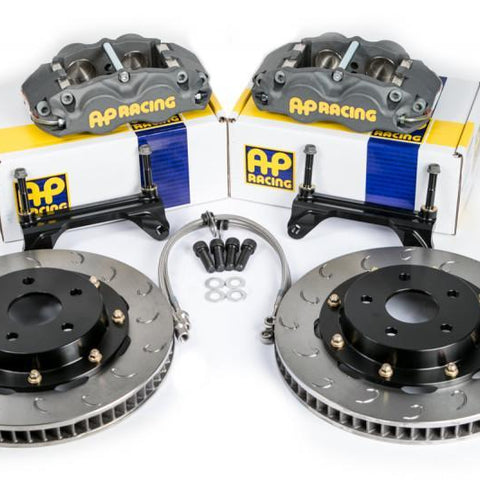
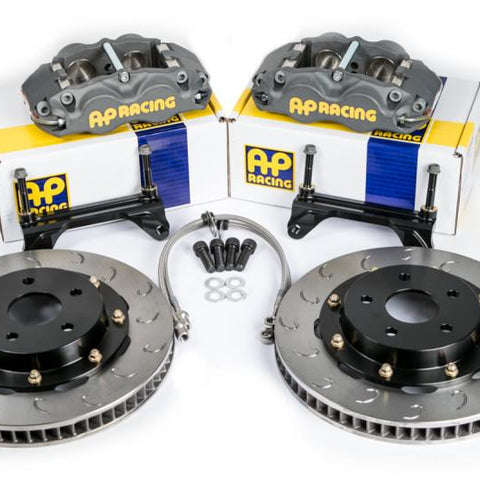
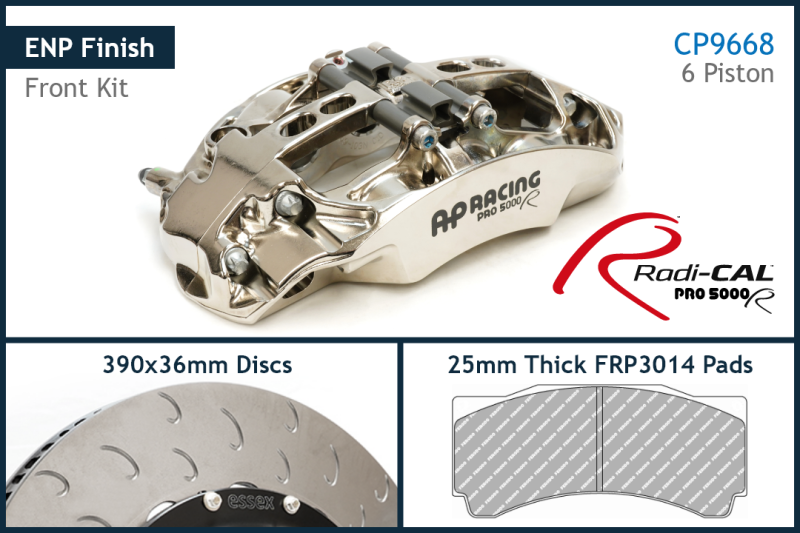
The CP9668 / 390mm package takes everything we like about AP Racing's six-piston Radi-CAL system and pairs it with a larger 390x36mm, 72-vane fully floating J-Hook disc for additional thermal capacity on seriously fast, heavy, and heavily aero-loaded C8 Corvettes.
A driver can adapt to almost any reasonable brake torque. What destroys confidence is a pedal, bite point, or response that changes as the session progresses.
Caliper stiffness, stainless pistons, racing seals, and rigid lines reduce the variables between your foot and the brake pads.
Huge 390x36mm racing discs and 25mm-thick pads provide substantial heat capacity for sustained high-energy braking.
A stiff caliper gives the driver a clearer relationship between pedal pressure and braking torque instead of hiding it behind component flex.
Pads, discs, seals, pistons, and other wear components are designed around the reality that race brakes eventually need service.
We ran AP Racing brake systems exclusively on our C5 race car for seven years. During that time, we never once gave serious thought to whether the braking system was capable of doing what we were asking from it.
We're now asking the same thing from a roughly 3700-pound C8 running slick tires and substantial aero. Still no drama.
That's really the highest compliment we can give a brake system. When you're hurtling toward a braking zone, you have plenty of things to think about already. Whether the pedal is going to be where you left it should not be one of them.

Traditional brake calipers tend to look like boxes because that's a convenient shape to manufacture.
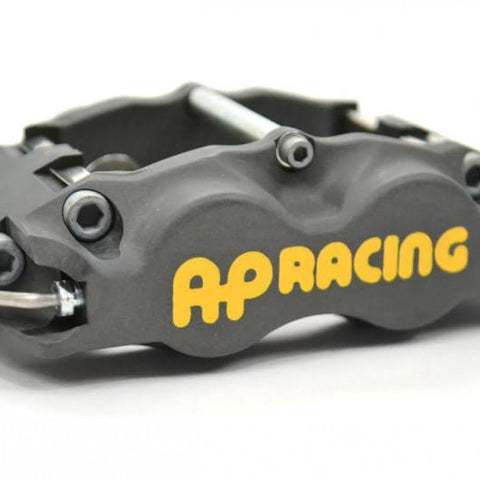
AP Racing's Radi-CAL architecture instead puts material where the caliper actually needs it during a braking event. The asymmetric shape is designed around the dynamic loads trying to twist and distort the caliper while the pads clamp a rotating disc.
The result is an architecture with more than a 30% increase in static and dynamic stiffness compared with conventional caliper designs while simultaneously removing unnecessary mass.
That's how you end up with a six-piston competition caliper weighing only about 6.9 pounds without pads.
Less caliper deflection means less pedal travel wasted bending the caliper, better modulation, and more consistent pad contact across the disc.
The CP9668 weighs approximately 6.9 lb without pads despite its six-piston architecture and substantial pad capacity.
No external crossover tubes means fewer vulnerable parts hanging off the caliper and more efficient packaging around the wheel.
Open space around the pistons and fluid pathways allows cooling air to move through the caliper instead of trapping heat inside a giant block of aluminum.
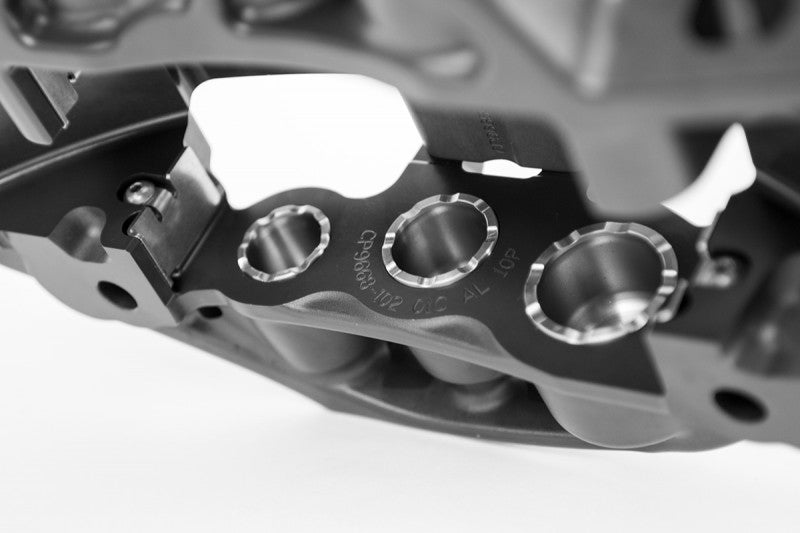
AP uses machined stainless-steel pistons rather than aluminum. Stainless steel transfers heat far less readily, helping create a thermal barrier between the screaming-hot brake pad and the hydraulic fluid behind it.
The pistons are ventilated and use a domed-back architecture for additional stiffness.
Behind them sit anti-knockback springs. During hard cornering, hub and disc movement can push the pads and pistons backward into the caliper. The next time you hit the brake pedal, you first have to take up that unwanted clearance.
The springs help keep the pistons where they belong, reducing the dreaded surprise long pedal when you arrive at the next braking zone.
Virtually every major detail in the Pro5000R exists because brake temperature on track is dramatically different from anything encountered during normal road use.
Motorsport-style high-temperature piston seals are designed to survive repeated high-heat operation without becoming brittle.
Bellows-style dust boots can burn and deteriorate at racing temperatures. Pro5000R calipers simply eliminate them.
Electroless Nickel Plating provides a durable, easy-to-clean surface that handles the heat and abuse of competition use.
The 372mm and 390mm versions use the same CP9668 six-piston Radi-CAL and the same enormous 25mm-thick pad architecture.
The difference is the disc. The 390mm system adds diameter, thickness, iron mass, and therefore additional thermal capacity. The tradeoff is exactly what you'd expect: more rotor also means more rotating mass and less room inside the wheel.
372x34mm disc weighing approximately 21.6 lb each. Lighter, easier to package inside smaller wheels, and already an extremely capable competition brake system.
390x36mm disc weighing approximately 24.3 lb each. More iron and more thermal mass for heavy, fast, high-aero cars repeatedly dumping huge amounts of energy into the front brakes.

This package was developed with the thermal demands and packaging of the C8 platform in mind, including the substantially higher performance envelope of the Z06.
The larger disc doesn't change what the CP9668 caliper fundamentally does. It simply gives the system more iron to absorb and reject heat before temperatures start running away from you.
If your C8 is heavy, fast, running slicks, making substantial aero, or spending long sessions repeatedly smashing the brakes from serious speed, this is where the larger disc starts making sense.
AP designed the Pro5000R around frequent race-car maintenance.
The standard bridge bolts come out with a simple 6mm hex wrench without removing the caliper from the car.
The CP9668 also includes a quick-change spring-clip bridge. Squeeze it, lift it, pull the pads out. In many cases you'll spend more time removing the wheel than actually changing the brake pads.
The caliper gets most of the attention, but the disc is where the kinetic energy of the car actually becomes heat. Consequently, a huge amount of the engineering in this system lives in the rotor assembly.
The iron ring can grow radially as temperature increases without forcing the aluminum hat to follow that expansion, reducing coning, distortion, stress, and uneven pad contact.
Left- and right-specific curved internal vanes actively pump cooling air through the disc rather than relying on a generic non-directional internal structure.
AP's J-Hook slot pattern provides pad-face cleaning and bite while promoting more uniform thermal behavior across the disc face.
Heat-treated aluminum hats reduce unnecessary rotating mass while reducing heat conduction into the hubs and wheel bearings.
That sounds obvious, but accommodating thermal expansion is one of the fundamental differences between a serious racing rotor and a conventional one-piece road-car disc.
When a constrained iron disc heats and expands, it can distort into a cone. Once that happens, the pads are no longer meeting a flat disc. Pad taper, judder, inconsistent pedal travel, and cracking can follow.
AP's fully floating architecture allows the iron ring to expand relative to the hat while continuing to run true in the caliper. This is not a styling feature. It's how a racing disc survives repeated thermal cycles.
The bigger 390mm disc intentionally carries more iron than the 372mm version because thermal capacity is the reason this version exists.
Even so, the lightweight Radi-CAL architecture and optimized two-piece rotor package keep total unsprung mass under control.
~9 lb lighterThe complete 390mm front package saves approximately nine pounds of unsprung mass compared with the factory C8 Z06 iron brake system.
Compared with the factory Z07 carbon-ceramic system, the entire front package carries only approximately a six-pound weight penalty while replacing extremely expensive carbon-ceramic consumables with comparatively affordable racing iron.
Essex selects piston sizing specifically around the C8 so the front kit works with the factory hydraulic and electronic architecture rather than treating the Corvette as a generic chassis with a brake bracket attached to it.
Caliper piston area is selected to work with the factory master cylinder rather than requiring a wholesale hydraulic-system redesign.
Piston sizing and brake torque are selected around the C8's original hydraulic architecture and intended axle relationship.
The front CP9668 package can be installed with the OEM rear braking system or paired with the corresponding AP Racing by Essex rear kit.
The CP9668 / 390mm system is mechanically compatible with the C8 Z06 Z07, and numerous Z07 owners are successfully running AP Racing front and rear systems.
However, the Z07's ABS, PTM, eLSD, Magnetic Ride Control, tires, and braking hardware were calibrated together around a very narrow factory performance envelope.
Essex testing has shown that some Z07 cars may experience smoother or reduced ABS intervention when the factory rubber brake hoses are retained rather than installing the supplied stainless-steel lines.
If retaining the OE hoses on a Z07, the factory banjo bolts and crush washers must be replaced with the appropriate hardware supplied by Essex.
Diameter is only part of brake-to-wheel fitment. Caliper width, spoke profile, wheel barrel diameter, and offset all matter.
Confirmed no-spacer applications currently include the factory C8 Z06 Z07 20-inch 5-spoke front wheel, the factory Z06 20-inch 10-spoke forged wheel, and the Forgeline SS1R 19x11 ET38.
That does not mean every 19- or 20-inch wheel fits. Verify your specific wheel using the template before ordering.
Download Wheel Fitment TemplateThe Pro5000R architecture prioritizes track performance, heat tolerance, low mass, rapid servicing, and pedal consistency.
That means features you might expect from an OEM street caliper—most notably external rubber dust boots—are intentionally absent. Competition pads can also make noise, and depending on pad dimensions and whether a tension kit is installed, some pad rattle may be present.
If your priority is silence, road salt, winter corrosion protection, and never thinking about brake maintenance, you're looking at the wrong category of brake system.
If your priority is repeated braking at race-track temperature, you're in exactly the right place.
We actually prefer it that way.
Brake compound selection depends enormously on tire, vehicle weight, track, driver, session length, temperature, and personal preference. Stuffing a generic set of pads in an expensive race brake kit simply so the box can say "pads included" doesn't do anyone a favor.
The CP9668 uses one of the most common large motorsport pad shapes on the market, allowing you to choose the compound that actually makes sense for your car.
We stock G-LOC pads specifically for the CP9668 / CP9669 family in the proper 54mm radial depth and 25mm thickness, supplied without the retention eyelet that otherwise needs to be ground or cut off before installation in the Pro5000R caliper.
Pad-tension / anti-rattle hardware is optional rather than included. This allows the caliper to accommodate pads from a wide range of manufacturers while giving customers who care about paddock or street NVH an additional noise-control option.
Shop G-LOC Pads For CP9668 / CP9669Read the complete Essex C8 front-brake installation procedure before taking the car apart. One particularly important C8-specific step: disconnect the battery before opening the hydraulic system.
View Installation Guide →Print the template at 100% scale and physically check your wheel. A 390mm disc needs considerable radial clearance, and wheel diameter alone still doesn't guarantee clearance around the CP9668.
Download Fitment Template →These kits are expensive. So are tires, entry fees, engines, bodywork, and mistakes caused by arriving at a braking zone without complete confidence in the pedal. AP Racing Competition systems are built so the brakes become one less variable between you and a fast lap.